
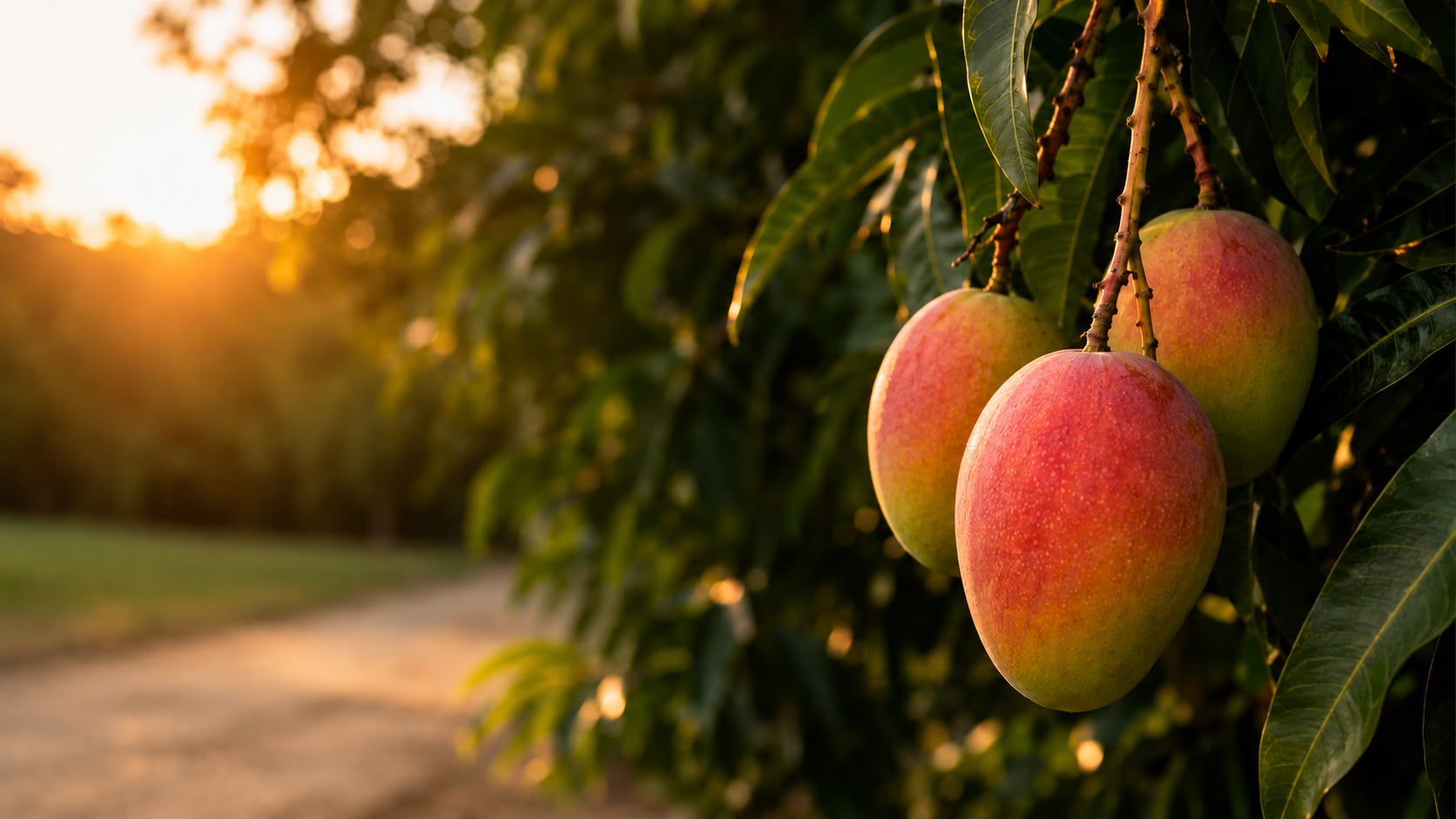
Beneath the shade of a mango tree in Trinidad, childhood memories, family and belonging take root. The Mango Tree is a tender reflection on the places that shape us and the ties that call us home.

We met through what could only be described as fate. One dark, gloomy Sunday evening, I saw him running across the hill. Running as though his feet could propel him into the air, so he might take flight and fly far away, soaring into the sky, far from whatever turmoil he was trying to escape. And it was in that moment, with the wind tousling his hair and the wild look in his eyes, that I realised he would be mine.
He stopped suddenly, startling me. Trying in vain to catch his breath, he rested his hands on his knees. I stood still, not wanting him to realise that I had been staring and was fully enthralled by him. He ran up to me. Wiping the sweat from his brow, he looked at me and plopped down.
“Hi,” he said. “Hope you don’t mind the company. I won’t be a bother. I just need to rest a bit—and talk, if you’re up for it.”
And just like that, we became friends.
Paul, as he said he was called, was the oldest of three siblings. He told me that sometimes he just needed to get away, to leave everything behind. Sometimes, it was the excessive responsibility placed on him as the eldest sibling, and sometimes it was simply the monotony of his life. Whatever it was, he always told me.
Each harrowing story, each silly anecdote—I relished seeing the animation on his face as he spoke. I drank in every word happily, soaking up as much of him as I could. Soon, his visits became so frequent that I was almost convinced he felt the same way I did.
Whenever he visited, he would prop his body against mine, resting his heavenly head on me. My most treasured compliments from him were what a good listener I was and what a safe space this was for him. A place where, as he put it, he could just be himself.
Oh, Paul. If you only let me, I would listen to you forever. I would always be your safe place. Always.
When we were older, we could run away together and become the kind of story that love stories were made of. We would be the story the elderly told their children about—the love story of Paul and Julie and their forever love for each other.
And just as suddenly as the whirlwind way we had met, things changed. Paul stopped visiting me.
Had he not confided in me for the past year? Come to me and unburdened himself? Had he not fallen asleep next to me so many times while I gently stroked his cheek as he slept? I had listened to him without sharing my opinion—not even once!
Why now did he choose to visit me less frequently? Was his mother ill? Was his drunkard waste of a father back in his life? Had I done something wrong?
How I wished I could visit him, if only to know how I could remedy whatever had angered him.
As time passed, I grew distant from my own family. Desperate for word of Paul, I stopped nourishing my body and grew quite thin. Nothing made me happy anymore.
Then, like a ray of sunlight on a dark, gloomy day—a day just like the one on which we had met—Paul strolled back into my life. And at that moment, I felt radiant.
As he walked towards me, I suddenly became very self-conscious of my appearance. I could imagine what he would say.
“Wow, Julie. Well, don’t you look thin?”
But before I could think of a crafty response to his banter, something caught my eye.
Paul’s fingers were interlaced with—
It couldn’t be.
No. My malnourished state was clearly affecting my sight.
But climbing the hill towards me was my Paul, his fingers interlaced with a vile wretch, a bottom-feeding sea urchin, a revolting enchantress who smiled smugly as she approached me. They stopped abruptly.
She giggled—a hideous sound, like rats caught in traps, fighting for their lives—and ran back down the hill, saying she would return with an umbrella as it was sure to rain.
Paul continued towards me at a steady pace.
We had a lot to talk about, and I was going to demand an explanation for the abominable scene I had just witnessed.
As he reached me, he turned his back without uttering a word. Taking a pocketknife from the pocket of his torn jeans, he began carving something into the tree opposite where I stood.
From my vantage point, it looked like a heart. Oh, Paul. You did love me after all. You were symbolising your love for me by carving our initials. Of course, I didn’t like seeing the destruction of a tree, but you were doing this to demonstrate to that she-devil where your heart truly belonged. My heart was full.
But as he stepped away, I saw the truth. The heart on the tree did not hold P & J Forever. It read:
P & S.
Who was S, Paul? Who was S?
And as though my heart already knew the answer, I heard him whisper, “Paul and Sarah forever,” with a sickening smile on his face. It all made sense. Paul had found himself a girlfriend.
Sarah.
Apparently, the umbrella-seeking miscreant. Had I not stood in the rain with you, Paul? When it poured and poured, had we not stood together? I never once asked for an umbrella. But no. You had betrayed me. Broken me.
And as I stared down at you, I knew what I had to do. With the wind gusting and the sky becoming darker, I let my thin, fragile limbs leave my body in unison with a loud creak.
You looked up just in time to see them suspended in mid-air before they came crashing down on you. You had broken me. And I was determined to break you. For you see, never mess with Julie, the mango tree.
If you enjoyed reading The Mango tree, stay with us.
Cocoa & Coconut tells stories Caribbean women are living – across the islands and the diaspora.
Join The Cocoa & Coconut Letter