
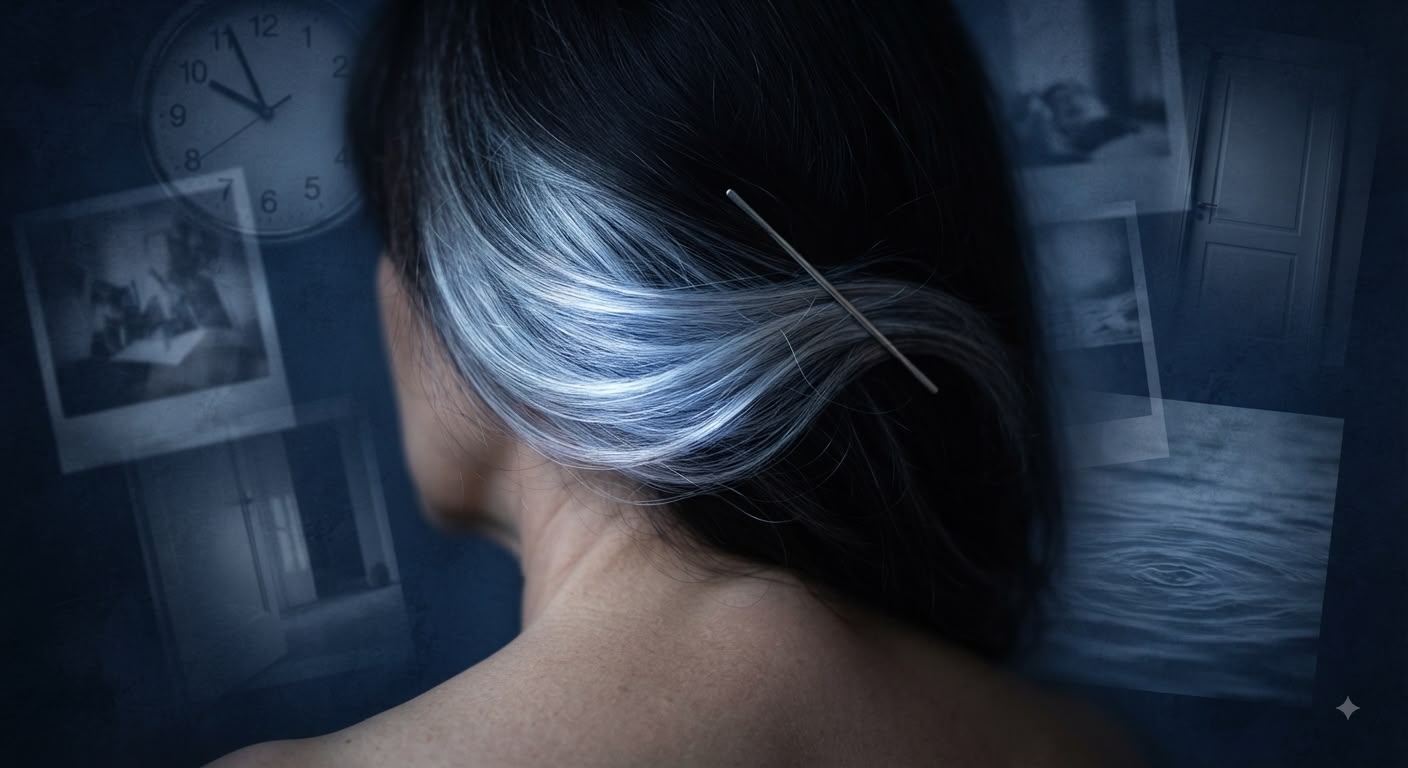
“The silver felt honest. It reflected not only loss, but survival.”
After the death of her partner, Nadili Soman stopped colouring her hair. What followed was not simply a story about grief, but a powerful reflection on identity, ageing, and the lifelong work of becoming.

The bottle of dye sat on the bathroom shelf for a year before I threw it away. My partner had been dead for seven months.
Grief, in those days, had a texture like the weather. It settled over the house and stayed. It was his coffee cup, sitting clean but unused in the drying rack. His shoes by the door, angled the way he’d stepped out of them. The silence sitting in his chair like a guest who wouldn’t leave. I moved through the rooms of my own life like a woman visiting a house she used to own. I would find myself standing in the hallway, looking at things we had bought together, unable to remember the woman who had chosen them. One ordinary day, I looked up. There she was in the mirror. Me. Except I didn’t recognize her. She was older than the woman I carried in my head. Thinner in the face. Tired in a way sleep doesn’t touch. The shock was small but unmistakable, the way you flinch at a photograph that catches you mid-sentence, unguarded. “So this is what a hollowed woman looks like”, I thought. For months, I had stayed clear of mirrors. I had no interest in dressing up.
I might have looked away. I nearly did. But something at my hairline caught the light and held me there. A few strands of silver, bright against the dark. I swear to you, they didn’t look like ageing. They looked like something that had been through a fire. I leaned closer. I have never in my life looked at anything the way I looked at those strands of silver. We’re taught to read them one way, aren’t we? As the beginning of the end. As the thing you catch early and cover before anyone notices. As proof you’ve stopped caring. But that wasn’t what gleamed back at me. What I saw looked forged. Tempered.
I let the bottle stay on the shelf. A few months later, I let it go in the bin. I learned early to hold myself together. I come from an Indo-Caribbean family, from a world of women who held things: households, husbands, grief, each other, with hands that never seemed to shake where anyone could see. Some of them were magnificent. They carried whole families across hard water, through deaths, divorces, and poverty, and never let you glimpse how heavy the load was. They woke up with smiles, cooked, cleaned, smoothed over arguments, and presented a flawless face to the outside world. Others were drowning, in plain sight, their sadness vibrating beneath the surface of holiday dinners and family gatherings, and we all looked politely away. The discomfort at looking too closely seemed worse than the truth itself. In our kitchens, the air was always thick with the scent of roasted cumin and fried bakes. We talked about recipes, the weather, weddings…anything to keep from addressing the quiet fractures running through the foundation of our lives.
My own mother went under before I ever really knew her. I have no memory of her voice. I do not know if she laughed loudly or if she spoke with her hands. What I have instead is her absence, a shape I grew up pressed against, the way a tree grows around a stone until the stone becomes part of the trunk. You cannot separate them anymore. You wouldn’t know where to cut. I spent years looking at faded photographs of her, trying to trace the geometry of her face, wondering if the way I tilted my head when I was thinking was an echo of her. I was looking for a map in a blank space. So I did what motherless girls do. I watched. I studied the women around me the way other children study their letters. I watched the aunties who laughed loudly, danced while cooking, and seemed entirely unbothered by the glorious mess of children and spilled food. This one, I’d think, I want to become like her. I looked at the others too: the ones who were loud in appearance wearing ice in their eyes. And this one, never. From all of them, I pieced together my own definition of a strong woman.
But the lesson underneath all the others was this: don’t break. Don’t fall apart. Never, ever fall apart where anyone can see. That lesson saved me more than once. I won’t pretend it didn’t. It got me through difficult jobs, broken relationships, and the daily pressures of building a life. But grief finally taught me its limit. Because there comes a night when holding yourself together is no longer strength. It’s just a locked door with someone weeping behind it. Here is what nobody tells you about grief. It doesn’t only take. It reveals. I had spent most of my life believing the world would meet me halfway if I only tried hard enough. I believed that if I loved deeply, worked hard, and planned carefully, life would eventually return the favour. Then he died, and that belief died in the same breath. There was no planning for the suddenness of his absence. I was left standing in the wreckage of my own certainty, holding a truth too heavy to put down: some things cannot be fixed. Some things you do not get over. You simply absorb the weight, adjust your stride, and learn to walk with the limp.
Yet there is a strange freedom on the far side of that ruin. When you finally stop trying to solve the unsolvable, your eyes open. You notice the slant of the light on the kitchen counter at four o’clock. The rhythmic, holy sound of your own breath in an empty room. Your own face, finally. I remember reaching up and touching those first silver strands almost cautiously, as though they belonged to someone else. They felt exactly like the rest of my hair. Soft. Ordinary. Yet I couldn’t stop looking at them. It struck me that they had arrived while I was busy surviving. They had grown during the sleepless nights, the long days of weeping, the hours of learning how to breathe again. They had witnessed everything I had lived through.
For the first time, I wanted them to be seen. I stopped colouring my hair because I no longer had the energy to keep a stranger alive: the woman who still thought life was negotiable. Maintaining her felt like visiting a grave and pretending it was a home. The silver was true. It knew where I’d been. It knew I had made it out. The world grew uneasy. As the silver became more visible, the women in my life, bless them, began to speak up. They offered practical, unsolicited advice. If you’re looking for a change, they told me gently, just go cut your hair. Take a trip. Do some yoga. They made light jokes about ageing, but their voices carried a gentle but unmistakable worry. It was the same tone people use when they notice a window has been left open in a hurricane. They looked at my hairline as if it were a vulnerability I had forgotten to hide.
Men reacted differently, with the sole exception of my father. Daddy was entirely clear with his dislike. He looked at my changing hair with the traditional anxiety of his generation, seeing it as a sign of neglect, or maybe a nagging reminder of his own ageing. “I don’t like it,” he told me flatly, looking at me across the living room. “You know I would tell you the truth. I know what looks good.” He would shake his head, genuinely distressed by my choice. Other men noticed the change and admired it. They encouraged me to keep it. At first, their praise felt like a relief, but the more I thought about it, the clearer the divide became. The men could afford to admire the silver because their worth had never been tied to hiding it. For them, it was an aesthetic choice; for the women, it was a boundary line they had been trained never to cross.
That is when I realized that the anxiety we feel about getting older is not something inherent to us. It is a habit we inherit. We pass it carefully from one woman to another, from mother to daughter, sister to sister, believing that this constant vigilance is a form of care. We treat the physical markers of our time on earth as flaws to be corrected, rather than proof that we are still here. In the worst of the heaviness, I had felt as if I was fading away. When life disrupts completely, it feels like erasure. It feels like stepping into deep, dark water that closes over your head until the person you used to be is completely gone. But I was not disappearing. I was simply becoming. The lines on my face and my silvered hair did not mean my life was winding down. They were markers. They meant I did not give up.
I know now that grief does not mean you will never feel joy again. You will. It simply pauses that capacity until you have the strength to carry it. I know too, that growing older is not a disaster we need to outrun. We have limited our definition of growth by assuming it belongs only to the young, expecting everyone else to remain unchanged, like fruit preserved in a jar on a shelf. I did not want the sorrow that remade me. I would give up every drop of wisdom I have clawed out of the dark just to have him back, to be the woman who didn’t know this kind of pain. But that option does not exist. The only choice left to me was whether to spend the rest of my life mourning who I had been or learn to love the woman who remained.
I choose love.
If What the Silver Knew felt familiar, stay with us.
Cocoa & Coconut tells the stories Caribbean women are living – across the islands and the diaspora.
Join The Cocoa & Coconut Letter